

Is it just me, or has the subscription pricing model gotten completely out-of-control over the last few years?
When I first started working with creative software (Photoshop and Dreamweaver at the time), releases were expensive, but also a one-time cost. Once you were invested into that product ecosystem, there were even discounts for future releases. Best of all, you weren’t required to upgrade. If the old version worked for you, keep on using it and invest that money elsewhere. I used my student discount at the time, and milked those versions as long as I could.
Remember, we’re not about spending money for the sake of it here.
Today the paradigm has changed. It’s flipped so thoroughly that it can be difficult to find software that you can actually buy.
What the hell happened? And what can we do about it?
Adobe’s Elephant in the Room
I think a huge part of what got us here is the fact that Adobe has become a monopolistic juggernaut in the creative space.
Remember when I mentioned Photoshop and Dreamweaver in the intro? At the time, those were owned by two distinct companies: Adobe and Macromedia. Each of them had a suite of creative products, and they were part of a larger market with actual competition.
Over time, mergers and acquisitions consolidated creative software into a few huge companies, and competition all but disappeared. Just recently, in fact, Adobe bought Figma, which has been challenging its dominance in the space, for $20 billion.
So now if you want to use industry standard tools, you’ve got one or maybe two companies to shop from.
Learn to Fish? Just Subscribe to A Fish Delivery Service
Somewhere along the lines, companies began figuring out that selling a product was far to much of a one-time injection of cash. Rather, creative tools began migrating to what’s called a SAAS model. SAAS stands for Software as a Service, and means that you no longer buy software: you rent it.
That’s right, instead of shelling out a few hundred bucks for Photoshop or Illustrator, you can now subscribe at a monthly rate that might seem low enough at first.
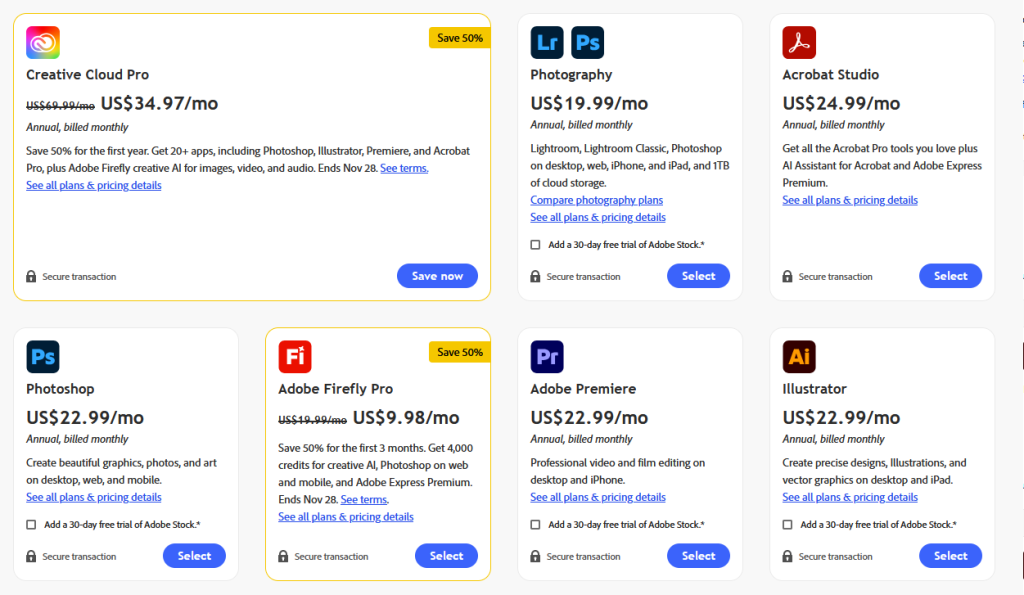
At the time of writing, you can get the entire suite of Adobe products for $34.97 per month. That’s with a healthy discount. Normally, it goes for about $70 a month.
At regular price, you’re looking at about $840.00 per year before any applicable taxes and fees. Maybe it’s just me, but that seems like a hell of a lot of money.
But Isn’t The Subscription a Good Deal?
The last time Adobe released products with individual perpetual licenses was the CS6 suite but in 2012. At the time, just Photoshop would run you $700, and if you wanted part or all of the suite, you’re going to be spending $1,200 to $2,600.
That’s a lot of cash, and it makes the subscription look like a pretty good deal at first glance.
But there are a few things you have to keep in mind. First of all, that was base pricing. If you owned a previous version, the upgrade cost was significantly less. There was an initial investment, but once you were in, upgrades were much more palatable.
Second, most people I knew didn’t buy the whole suite because they didn’t need it. One of the cheaper bundles got them everything they needed.
Third, everyone I knew who was buying this stuff as a freelancer would use it for years. so it didn’t take very long before the current $840 per year subscription model became more expensive. What was once a one-time investment in tools you needed, became just another unavoidable monthly expense.
So What Can We Do About it?
To those of you like me who are yearning for the good old days of perpetual licenses, there is some good news out there. While Adobe is undoubtedly a juggernaut in the space, there is competition, especially against its biggest products: Photoshop, Illustrator, and Premier.
In fact, there is software that you can completely for free to replace some of these products. Some, like Black Magic Design’s DaVinci Resolve is as good as or better than what you might be replacing. For others, you’re definitely going to be making some sacrifices.
I’ll do a follow-up or two looking at these software alternatives in more detail down the road
The downside here is that you need to learn new workflows and find ways to transfer existing projects into new tools. That’s a drag, I know.
But the more people who reject the subscription-based pricing model and seek out competition, the weaker Adobe’s stranglehold becomes.
¡Viva la revolución!
Header image by Clint Hilbert.